A highlight of the international street paper calendar is the INSP conference, hosted in a different city each year, in partnership with the local street paper member. The 17th annual conference is in Munich in partnership with BISS. Here is a round-up of tweets, blog posts and other coverage.

Showing posts with label Conference 2013. Show all posts
Showing posts with label Conference 2013. Show all posts
6 August 2013
INSP Conference 2013 photos

More will be uploaded throughout the week, if you have any photos you wish to share click here to send.
Photos by conference photographer Stephanie Dillig (high resolution)
Google+ Photos


2 August 2013
2013 International Street Paper Awards - the winners
The winners of the 2013 ‘International Street Paper Awards’ were announced last night at a ceremony in Munich on the final night of INSP's 2013 annual conference. The awards highlight the outstanding, independent editorial achievements of street papers; and their contribution to social justice.
Ten awards were presented in total, across nine different categories. Winners were presented with hand-made made awards created by Glasgow Wood Recycling – a social enterprise that offers volunteering and training as a way of tackling poverty and social exclusion. The winners were:
INSP Executive Director Lisa Maclean said of the awards: “The International Street Paper Awards are a real celebration of the diversity of our member street papers around the world. Street paper editors, journalists, designers and photographers work hard every day to report on important issues and create first-class magazines and newspapers for their vendors to sell. It’s great to have the opportunity to celebrate and reward these efforts and remind the world what street papers are there to do."
For more information about all the finalists, click here.
Sponsors:

 |
| Best Cover |
- Best Feature Story – Writing for social impact:
'Storm about the Shelters' by Ryan Gallagher, The Big Issue in the North (UK) - Best Cover – Making a statement on the street
'Face to Face' by Lisa Mansfield, The Big Issue Australia - Best Interview – A spotlight on change-makers
'Mayoral Candidate Conversations' by Andrew Krinks, The Contributor (USA) - Best Photograph – Evoking deeper perspectives on poverty and injustice
'In the Bathtub' by Helga C. Theilgaard, Hus Forbi (Denmark) -
Best Vendor Essay – A fresh perspective from the street
'Our daily bread' by Andrea Hoschek, Apropos (Austria) - Best Design – Effecting change through visual content
'Christmas book 2012' by Dimitri Koutsomytis, Anlov Peter Mathiesen and Svein Johan Reisang, =Norge (Norway) and 'The Diamond Jubilee Edition' by Mark Neil / The Big Issue UK design team, The Big Issue UK (joint winners)
Best Photo
- Special Award for External Press – Advocating for the needs and rights of homeless people
'Special Report – Homeless Banker hits rock bottom' by Jonathan Owen, The Independent on Sunday (UK)
- Social Development Award – Innovation in vendor support: The Big Issue Australia
- Social Enterprise Award – Business success for social good: =Norge
The final award of the evening went to The Big Issue South Africa for Outstanding Contribution to the International Street Paper Movement. The Big Issue South Africa leads the way for sustainable street paper development on the continent, supports colleagues in other African countries and also supports the development of INSP as an organisation.
INSP Executive Director Lisa Maclean said of the awards: “The International Street Paper Awards are a real celebration of the diversity of our member street papers around the world. Street paper editors, journalists, designers and photographers work hard every day to report on important issues and create first-class magazines and newspapers for their vendors to sell. It’s great to have the opportunity to celebrate and reward these efforts and remind the world what street papers are there to do."
For more information about all the finalists, click here.
Sponsors:

1 August 2013
Group discussion: who should we be supporting?
The global economic crisis has changed the demography of homelessness and unemployment. Record numbers of families are now homeless and many European street papers are seeing large increases in homeless people from Romania and Bulgaria. The discussion on the final day of the INSP conference concerns the question: “our vendors: who should we be supporting?”
The delegates were split into four groups, each focusing on a different vendor support issue in order to create a clear picture of how the demography of homelessness is shifting and what street papers will have to do in order to adapt to new vendor groups.
Debate focused around four key questions: What are the needs of our vendors and how have these changed in recent years? How have street papers responded to those needs? What are the related challenges? What does the future hold for street papers in relation to vendor support?
Groups 1a and 1b, led by Fay Selvan (Group Chief Executive at The Big Issue in the North, UK), Bastian Pütter (Editor-in-Chief of Bodo, Germany), Frank Dries (Editor of Straatnieuws, the Netherlands) and Des Sharples (National Sales Manager at The Big Issue UK), looked at economic migration. The number of Roma and other economic migrants continues to increase across cities in Europe, forcing street papers to decide who to support and how to support them. Fay Selvan from The Big Issue in the North, states that, "Roma are
the most discriminated against ethnic minority in Europe today, it is
not just about giving them a job, but also about campaigning against
something that is not democratic and goes against human rights."
For some street papers, over half of the vendors are Roma, while others exclude them from selling entirely. Delegates discussed these difficult choices as well as looking at the need to adapt existing services to meet different needs while also continuing to support existing vendors. One of the most important points discussed was the necessity to closely analyze the specific needs of Roma and how to meet them, for example: overcoming the language barrier and
providing child daycare for the Roma children. Another important aspect is the public opinion about Roma. A project of shared investigative journalism between several street papers was proposed which would help refute myths about the Roma community in general and Roma vendors in particular. With the number of Roma increasing in most countries and with a rising number of Roma street newspaper vendors, giving this group a positive visibility in the magazine itself is a good way to educate and inform the public.
Group 2, meanwhile, focused on the issue of homelessness caused by the financial crisis. As mentioned above, the global economic downturn has led to an increase in unemployment and homelessness across many countries. This, in turn, has placed increasing demand on street papers as more people look for ways to earn an income. Henrique Pinto (Executive Director of Cais, Portugal) and Chris Alefantis (Editor-in-Chief of Shedia, Greece) looked at how street papers can cope with this pressure and discussed how they can continue to offer support services even when governments continue to cut welfare budgets.
The discussion focused on whether or not vendor should be reintegrated in the regular labour market. "I don't see why selling a street paper shouldn't be considered a proper job," argues Patricia Merkin from Hecho en Bs.As. (Argentina).
The Women’s Subscription Enterprise allows women to earn a stable income in a job that keeps them safely off of the streets. It has the additional bonus of allowing the street paper to reach remote customers, widening its readership and increasing its income.
Group 4 discussed the International Street Paper Vendor Week. In February 2013 INSP launched its first-ever Vendor Week, an international programme of events and activities celebrating street paper vendors, championing their entrepreneurial spirit and challenging perceptions of homelessness and poverty.
INSP’s Development Manager, Maree Aldam, along with Shawn Bourdages (Communications and Fundraising Assistant at L’Itinéraire, Canada) and Cole Merkel (Vendor Coordinator at Street Roots, USA), spoke of the success of this year’s Vendor Week – 46 street papers from 20 countries participated, involving around 8,000 vendors and reaching 70,000 readers worldwide.
Furthermore, the Vendor Week was covered in the mainstream media as well. In Scotland, for example, there was a slot on national television.
The group leaders then asked the delegates to share how they participated. Brittany Langmeyer, publisher at StreetWise, USA, reported that they organized an Instagram competition. The aim was to get to take as many pictures with vendors as possible and upload them. The winner was rewarded with free copies of StreetWise for a month. Shawn of L'Itinéraire talked about the open house sessions they organized during the vendor week, where customers could visit the office rooms of the paper and meet vendors as well as staff of the paper.
However, some delegates highlighted that vendors should be the centre of our efforts each and every day and not just for one week per year.
"It is like mother's day - you celebrate it on a special day every year, but in fact, it is even better if you show love to your mother every day," Dijana Gjorgievska, President of Ulica, Macedonia, concluded.
The importance of the Vendor Week was underlined by Maree who pointed out that it is specifically about the people who sell the papers. What INSP wants to achieve with Vendor Week is for the public to really understand the street paper concept, to raise awareness and, finally, to increase sales. Although INSP does not launch any programs for the vendor week on its own, it puts an umbrella over all the projects street papers all over the world do, showing that it is a powerful international movement.
After the final discussion session of the conference each group was asked to report back on their discussions with all feedback being collated for the conference report.
The delegates were split into four groups, each focusing on a different vendor support issue in order to create a clear picture of how the demography of homelessness is shifting and what street papers will have to do in order to adapt to new vendor groups.
Debate focused around four key questions: What are the needs of our vendors and how have these changed in recent years? How have street papers responded to those needs? What are the related challenges? What does the future hold for street papers in relation to vendor support?
 |
| Frank Dries (Straatnieuws, Netherlands) and Des Sharples (BI UK). |
For some street papers, over half of the vendors are Roma, while others exclude them from selling entirely. Delegates discussed these difficult choices as well as looking at the need to adapt existing services to meet different needs while also continuing to support existing vendors. One of the most important points discussed was the necessity to closely analyze the specific needs of Roma and how to meet them, for example: overcoming the language barrier and
 |
| Fay Selvan (BI in the North) and Bastian Pütter (Bodo, Germany). |
 |
| Henrique Pinto (Cais, Portugal) and Chris Alefantis (Shedia, Greece). |
The discussion focused on whether or not vendor should be reintegrated in the regular labour market. "I don't see why selling a street paper shouldn't be considered a proper job," argues Patricia Merkin from Hecho en Bs.As. (Argentina).
The changing demography of homelessness has seen an increase in whole families with no permanent address. Group 3, chaired by Trudy Vlok (INSP Vice-Chair & Treasurer and Managing Director of The Big Issue South Africa) and Steven Persson (INSP Secretary and CEO of The Big Issue Australia), discussed homeless families and especially the situation of female vendors since there is a big lack of women engaged in
the street paper work all over the world.
 |
| Discussion group: Female vendors. |
Women living in poverty are some of the most marginalised, vulnerable people in society. Many are solely responsible for supporting their families. Just like their male counterparts, female vendors have the opportunity to earn a sustained income by selling street papers but there are often additional challenges such as childcare and safety. Steven Persson underlined that
two essentials should be provided:
economic power and permanent secure housing.
Delegates discussed these challenges and possible solutions to them, including innovative approaches such as The Big Issue Australia’s Women’s Subscription Enterprise.
Delegates discussed these challenges and possible solutions to them, including innovative approaches such as The Big Issue Australia’s Women’s Subscription Enterprise.
 |
| Discussion group: Homelessness in financial crisis. |
In South Africa, female vendors are protected by a local security company which keeps them safe at their
working place. Trudy Vlok said: "In this case you have to fight against
victimisation, stereotyping, sexual
abuse, domestic violence and cultural disgrace."
Group 4 discussed the International Street Paper Vendor Week. In February 2013 INSP launched its first-ever Vendor Week, an international programme of events and activities celebrating street paper vendors, championing their entrepreneurial spirit and challenging perceptions of homelessness and poverty.
INSP’s Development Manager, Maree Aldam, along with Shawn Bourdages (Communications and Fundraising Assistant at L’Itinéraire, Canada) and Cole Merkel (Vendor Coordinator at Street Roots, USA), spoke of the success of this year’s Vendor Week – 46 street papers from 20 countries participated, involving around 8,000 vendors and reaching 70,000 readers worldwide.
Furthermore, the Vendor Week was covered in the mainstream media as well. In Scotland, for example, there was a slot on national television.
The group leaders then asked the delegates to share how they participated. Brittany Langmeyer, publisher at StreetWise, USA, reported that they organized an Instagram competition. The aim was to get to take as many pictures with vendors as possible and upload them. The winner was rewarded with free copies of StreetWise for a month. Shawn of L'Itinéraire talked about the open house sessions they organized during the vendor week, where customers could visit the office rooms of the paper and meet vendors as well as staff of the paper.
However, some delegates highlighted that vendors should be the centre of our efforts each and every day and not just for one week per year.
"It is like mother's day - you celebrate it on a special day every year, but in fact, it is even better if you show love to your mother every day," Dijana Gjorgievska, President of Ulica, Macedonia, concluded.
The importance of the Vendor Week was underlined by Maree who pointed out that it is specifically about the people who sell the papers. What INSP wants to achieve with Vendor Week is for the public to really understand the street paper concept, to raise awareness and, finally, to increase sales. Although INSP does not launch any programs for the vendor week on its own, it puts an umbrella over all the projects street papers all over the world do, showing that it is a powerful international movement.
After the final discussion session of the conference each group was asked to report back on their discussions with all feedback being collated for the conference report.
Day 3 round up: who should we be supporting?
The final day of the INSP annual conference centres on the most important aspect of the street paper model: the vendors.
The global economic downturn has resulted in a change of the demography of homeless and unemployed people. There are now often whole families without a permanent residence. Many street papers across Europe have witnessed an increase in vendors from Romania and Bulgaria in the last few years. So who is it that street papers should be supporting?
Lisa Maclean, INSP’s Executive Director, introduced the final day’s theme, followed by a speech by Freek Spinnewijn of FEANTSA (the European Federation of National Organisations Working with the Homeless).
FEANTSA is a European NGO which has been working for over 20 years to prevent and alleviate the poverty and social exclusion of people threatened by or living in homelessness. Freek gave an overview of the work he and FEANTSA have been doing and demonstrated the changing demographic of homeless people in Europe. "We are facing a massive increase in youth and family homelessness," he said. "Migration in many countries is a direct route into homelessness." For Freek one of the main questions in his work as an NGO is how to keep the European Union interested in the issue. "We're a bit lonely as an NGO adressing the EU, maybe also street papers could get involved."
Panellists Fay Selvan (The Big Issue in the North, UK), Chris Alefantis (Shedia, Greece), Cole Merkel (Street Roots, USA), Thiago Massagardi (OCAS, Brazil), Bastian Putter (Bodo, Germany) and speaker Freek Spinnewijn then tackled the final discussion question of the conference: “Our vendors: who should we be supporting?"
Chaired by Editor of street paper Z! (the Netherlands), Hans van Dalfsen, the panellists from these street papers, each with a wealth of experience dealing with different vendor groups, discussed the challenges faced in their work and how they have adapted to meet the needs of new vendor groups. From these experiences they hope to share with other street papers how best to adapt to, and include, new vendor groups.
During the discussion, Cole answered the question by stating: "We will engage with anyone who walks through our office door."
However, Bastian pointed out that "there are people we can't help, we can't provide help for everyone", referring to the high number of migrants from Bulgria and Romania.
Thiago mentioned that the question is not just "Who should we be supporting?", but also "How long should we be supporting our vendors?" Although not possible for every vendor, OCAS wants to provide a stage for them from which they can go on in their lives.
With the final day of the conference concluded the delegates are now looking forward to the awards tonight.
Bastian Pütter, Editor-in-Chief of Bodo, Germany, was presented as the new coordinator of the platform for German language platform. He succeeds Ilse Weiß in that position.
Furthermore, there was thanks given to Lisa, Executive Director of INSP, who will resign in the coming weeks.
Serge Lareault, INSP Chairperson and publisher of L'Itinéraire, and Hildegard Denninger, Managing Director of BISS, thanked the whole INSP staff, the volunteers, the BISS staff and the student reporter team.
 |
| Lisa Maclean welomes the delegates to the last day of the conference. |
Lisa Maclean, INSP’s Executive Director, introduced the final day’s theme, followed by a speech by Freek Spinnewijn of FEANTSA (the European Federation of National Organisations Working with the Homeless).
 |
| Freek Spinnewijn of FEANTSA. |
Panellists Fay Selvan (The Big Issue in the North, UK), Chris Alefantis (Shedia, Greece), Cole Merkel (Street Roots, USA), Thiago Massagardi (OCAS, Brazil), Bastian Putter (Bodo, Germany) and speaker Freek Spinnewijn then tackled the final discussion question of the conference: “Our vendors: who should we be supporting?"
Chaired by Editor of street paper Z! (the Netherlands), Hans van Dalfsen, the panellists from these street papers, each with a wealth of experience dealing with different vendor groups, discussed the challenges faced in their work and how they have adapted to meet the needs of new vendor groups. From these experiences they hope to share with other street papers how best to adapt to, and include, new vendor groups.
 |
| Panel discussion: Our vendors: Who should we be supporting? |
During the discussion, Cole answered the question by stating: "We will engage with anyone who walks through our office door."
However, Bastian pointed out that "there are people we can't help, we can't provide help for everyone", referring to the high number of migrants from Bulgria and Romania.
Thiago mentioned that the question is not just "Who should we be supporting?", but also "How long should we be supporting our vendors?" Although not possible for every vendor, OCAS wants to provide a stage for them from which they can go on in their lives.
 |
| Bastian Pütter (Bodo) will succeed Ilse Weiß as coordinator of the German language platform. |
With the final day of the conference concluded the delegates are now looking forward to the awards tonight.
Bastian Pütter, Editor-in-Chief of Bodo, Germany, was presented as the new coordinator of the platform for German language platform. He succeeds Ilse Weiß in that position.
 |
| Hildegard Denninger thanked the staff of INSP. |
Furthermore, there was thanks given to Lisa, Executive Director of INSP, who will resign in the coming weeks.
Serge Lareault, INSP Chairperson and publisher of L'Itinéraire, and Hildegard Denninger, Managing Director of BISS, thanked the whole INSP staff, the volunteers, the BISS staff and the student reporter team.
Paulaner Biergarten
 |
| The delegates enjoyed beer and typical Bavarian food at the famous "Paulaner Biergarten". |
 |
| Prost! |
With this in mind the delegates took a short walk to the famous Paulaner Biergarten to enjoy some of Bavaria’s finest beer and meet local vendors of the host street paper, BISS.
"It was a great evening," Andreas from Die Jerusalemmer (Germany) said. "I had good conversations with my street paper colleagues, we had an instant connection."
Aaron Israelson, Editor-in-Chief of Faktum in Sweden, agrees that INSP brings people together: "It makes you feel like you're part of something bigger. INSP is especially important for smaller street papers in developing countries."
 |
| Chris Alefantis (Shedia, Greece), Birgit Müller (Hinz&Kunzt) and Volker Macke (Asphalt). |
Paulaner is one of Munich’s oldest breweries. Paulaner monks have been brewing beer here for over 300 years, so you can bet they’re pretty good at it! Delegates also enjoyed traditional Bavarian food such as ‘Schweinshaxn’, ‘Lebarkas’, and ‘Obatza’.
During dinner delegates met some of BISS’s vendors. Some of the vendors with foreign roots were happy to talk to street paper members from their home countries.
 |
| The team of Surprise (Switzerland) and Gabi Koch (Hinz&Kunzt) |
In 2006 BISS bought a plot of land at a local graveyard to ensure long-term vendors received a proper burial when they died. It is clear to see that BISS epitomize the street paper principal that the vendor must be at the centre of all efforts.
Day 2 round up: surviving in the digital age
Changes in technology, from smart phones to social media, have changed the way we consume media. Major print publications have experienced a significant decline in readership with more and more people turning to the internet for free news websites. Street papers face a unique problem with the transition from print to digital media because the vendor-customer transaction is core to the street paper model and must be retained.
The second day of the conference focused on the big digital question. Delegates were given the opportunity to share their own digital development ideas and discuss new and emerging challenges.
Executive Director of INSP, Lisa Maclean, introduced the theme of the day before external speaker Christoph Knorn, from award-winning international design and technology agency CONRAD CAINE, gave a talk about the shift in publishing from print to digital.
Christoph showed delegates examples of the approaches mainstream media were taking with regards to digital output and discussed their relevance to street papers. He also explained the challenges and opportunities that digital media is bringing. According to him, "print is not dead, but shift happens". He said that there has always been a trend for convenience in media - just as buying music on iTunes is easier than getting a CD in the record store - and that street papers should be aware of this trend when developing new business models. The most important aspect for him: "Never let reality stop your imagination".
The second panel discussion then got under way. With the day’s theme in mind the question discussed by panellists was: “how do street papers survive in the digital age?”
Panellists Christian Lisseman (The Big issue in the North, UK), Brittany Langmeyer (StreetWise, USA), Dirk Meerkotter (The Big Issue South Africa), Aaron Israelson (Faktum, Sweden) and speaker Christoph Knorn discussed several street papers that were trialling different aspects of digital technology.
Among trials discussed by the panel – chaired by Sean Condon, Executive Director of Megaphone (Cananda) and Co-Chair of INSP’s partner network, NASNA – was the INSP digital street paper pilot.
The pilot scheme involved customers being able to get a digital copy of The Big Issue in the North (UK) for their smart phone by buying a QR code from vendors, maintaining the interaction between vendors and the public. Therefore, vendors will sell access to content rather than just pure content.
The panel also answered questions from the floor about cashless payments, app technology and online subscriptions, such as The Big Issue Australia’s Women’s Subscription Enterprise, which has allowed homeless women to gain safe employment while expanding the paper’s readership to more remote regions. Sean Condon of Megaphone (Canada) also explained a very interesting feature which his paper implemented: the so-called vendor finder, which enables buyers to track down their nearest vendor online.
After discussion and feedback sessions about the day’s topic, John Bird, Founder of The Big Issue UK, opened the innovation exchange. He made his aims very clear: "I don't want a person on the streets any longer than they have to be".
The innovation exchange saw street papers sharing brand new, innovative ideas to help generate extra income and awareness.
The Magazine Street Roots (USA) for example, used Twitter to document 24 hours in the life of a homeless person, giving a first hand account of how it feels.
Asphalt, from Germany, introduced their bicycle garage program, where vendors learn to fix and maintain donated bikes. Some of the vendors even found jobs in bike shops after training at the workshop. The Big Issue Australia shared their Women’s Subscription Enterprise.
Hempels (Germany) discussed their work with prisoners. Long term prisoners in the penal institution take part in writing workshops with finished articles then published in Hempels, giving readers a unique insight into life both in and out of prison while also helping prisoners to learn new skills.
Amongst other innovations brought forward were the use of open software in the production of The Big Issue South Africa. Dirk Meerkotter, the designer of the paper, turned to open source software for two reasons: "Not only can it improve our own work, but we can also improve the developer's work by giving them feedback".
Furthermore, the German street paper Zeitschrift der Strasse’s alternative business model was presented: The magazine focuses on provocative design, which challenges the reader to be more critical of their regular way of seeing things. For example, the top part of the magazine is inexplicably perforated, sparking questions in the reader and opening a conversation between vendor and buyer.
The Dutch papers Z! and Straatnieuws found a way to share resources and cut production costs by 25% with a joint collaboration. They were able to secure the existence of both papers with this new model and can now use their combined funds to focus on new projects, such as a national glossy street paper and a street paper designed for a younger audience.
While the street paper model faces a unique problem in the shift from print to digital there was no shortage of potential solutions on show.
The second day of the conference focused on the big digital question. Delegates were given the opportunity to share their own digital development ideas and discuss new and emerging challenges.
Executive Director of INSP, Lisa Maclean, introduced the theme of the day before external speaker Christoph Knorn, from award-winning international design and technology agency CONRAD CAINE, gave a talk about the shift in publishing from print to digital.
+042.jpg) |
| Christoph Korn from the design and technology agency CONRAD CAINE. |
The second panel discussion then got under way. With the day’s theme in mind the question discussed by panellists was: “how do street papers survive in the digital age?”
+027.jpg) |
| The panellists discussed the (digital) future of street papers. |
Among trials discussed by the panel – chaired by Sean Condon, Executive Director of Megaphone (Cananda) and Co-Chair of INSP’s partner network, NASNA – was the INSP digital street paper pilot.
The pilot scheme involved customers being able to get a digital copy of The Big Issue in the North (UK) for their smart phone by buying a QR code from vendors, maintaining the interaction between vendors and the public. Therefore, vendors will sell access to content rather than just pure content.
+047.jpg) |
| Sean Condon of Megaphone (Canada). |
 |
| John Bird (The Big Issue UK). |
The innovation exchange saw street papers sharing brand new, innovative ideas to help generate extra income and awareness.
The Magazine Street Roots (USA) for example, used Twitter to document 24 hours in the life of a homeless person, giving a first hand account of how it feels.
 |
| Jo Tein (Hempels, Germany). |
Hempels (Germany) discussed their work with prisoners. Long term prisoners in the penal institution take part in writing workshops with finished articles then published in Hempels, giving readers a unique insight into life both in and out of prison while also helping prisoners to learn new skills.
 |
| Dirk Meerkotter (The Big Issue South Africa). |
 |
| Michael Vogel (Zeitschrift der Strasse). |
The Dutch papers Z! and Straatnieuws found a way to share resources and cut production costs by 25% with a joint collaboration. They were able to secure the existence of both papers with this new model and can now use their combined funds to focus on new projects, such as a national glossy street paper and a street paper designed for a younger audience.
While the street paper model faces a unique problem in the shift from print to digital there was no shortage of potential solutions on show.
31 July 2013
Discussion: surviving in a digital age
With the theme of the day in mind, the discussion groups on the second day of the INSP conference focused on the question: “how do street papers survive in the digital age?”
Delegates were split into five groups to tackle various challenges and opportunities that are emerging from the rapid advancement of digital technology and to discuss its effect on the media landscape. They were asked to keep in mind the questions: What are the needs this technology/approach addresses? What are the related challenges and opportunities? What does the future hold for street papers?
Group 1 focused on the topic of digital subscriptions. Street sales are a priority to all street papers as they are the main source of income for vendors, however the opportunities are plenty when discussing the future use of the web.
John Bird (Founder of The Big Issue UK) and Dirk Meerkotter (The Big Issue South Africa) led the discussion on the benefits of subscriptions to reach more remote regions and new groups of readers. Most attendants agreed that it is a good idea to publish extra material on the internet, rather than just the magazine itself - to "add rather than duplicate", as John Bird put it. The Big Issue South Africa’s innovative digital subscription app inspired the group - what if there was an INSP app in the future that gave readers access to street papers from all over the world?
Since the demand for digital subscriptions seems to be underestimated in many places, there are many opportunities: tokens could be sold on the streets and vendors who either can't or do not want to sell on the streets could get an alternative chance to interact with the readers. The sky is the limit when the street papers enter the digital era and John Bird emphasized that "innovation is a bit like justice - it doesn't exist unless it can be seen being done".
Groups 2a and 2b, chaired by Christian Lisseman (Communication Team Leader at The Big Issue in the North, UK), Steven Persson (INSP Secretary and CEO of The Big Issue Australia), Fay Selvan (Group Chief Executive at The Big Issue in the North, UK) and Alan Attwood (Editor of The Big Issue Australia), debated the big digital question: print vs. digital. Street papers face a unique problem in adapting to digital technology as the vendor-customer transaction on the street is the core of the street paper model. The discussion group looked at various trials and pilot schemes and discussed their potential.
In particular they looked at the INSP digital street paper pilot. In partnership with The Big Issue in the North, customers could get a digital copy of the popular street paper on their phone by buying a QR code card from a vendor, priced equally to the print copy so that the vendor’s income is still assured. This has since been replicated by The Big Issue Australia.
The discussion participants discussed its success and possible improvements. "A digital copy is a first step, but it's not the future," Ilse Weiss from Strassenkreuzer said.
Christian Lisseman (UK) underlined that a digital version of a street paper is not meant to be a replacement for the printed version. It's rather to win more readers, in particular readers who don't want to buy the printed version.
Fay Selvan explained: "For me the experiment with the cards was very important, because it told us: if we're selling a digital version, it has to offer much more than a simple PDF copy of the print."
Birgit Müller (Hinz&Kunzt, Germany) wants to explore the cross-media opportunities an e-paper has to offer. In her opinion the digital version has to be completely different: "We could be very unique in our electronic media. We should highlight the opportunities of digitalisation rather than shouting 'Oh, we are all dying!'"
In the end all participants agreed to change the discussion's title to "print and digital". Hildegard Denninger (BISS, Germany) sees opportunities for the vendors' careers and personal development: "We will always have print, but we should also work with the digital – as it offers new job options for vendors, maybe part time in the beginning."
Group 3 focused on the possibilities of cashless payments. With credit and debit cards being widely accepted, an increasing number of people, especially younger, potential buyers, no longer carry cash, costing vendors valuable business. Discussion leaders Amy Roe (Editor of Real Change, USA) and Brittany Langmeyer (Publisher at StreetWise, USA) looked at a pilot scheme launched by Chicago-based street paper StreetWise, in partnership with digital payment experts at PayPal, which involved customers being able to pay for the magazine by smartphone.
Other possibilities to pay without cash are via text messages (the price for the street paper is charged by your telephone company and appears on your bill) or via NFC (Near Field Communication): you pay for a product by putting your smartphone equipped with a special chip in close proximity to a reader. However, there are some challenges for electronic payment: the vendor's willingness to learn about new technologies, the fees Apple and Google charge for apps in their app stores, the fact that many vendors prefer to get their money instantly - which is not always guaranteed with cashless payment - and, last but not least, the limited battery life of smartphones.
Erlend D. Paxal, Manager of the paper Sorgenfri from Norway, highlighted a crucial aspect: "All those systems we talk about right now are quite complicated to use, both for the vendor and the customer. What we really need are payment options which are as easy to use as cash or even easier - otherwise we will deter customers from buying our papers".
Group 4 discussions centred on digital marketing, and the benefits that an effective social media campaign can bring. Aaron Israelson (Editor-in-Chief of Faktum, Sweden), Patricia Merkin (Director of Hecho en BsAs, Argentina) and Maree Aldam (Development Manager at INSP) looked at how street papers can reach new readers and increase sustainability at minimum cost with the use of social media and other digital marketing tools.
Swedish street paper Faktum demonstrated this in 2012 with the launch of Faktum Hotels, a website where people can ‘book’ rooms in a homeless hotel – ‘amenities’ include filthy mattresses and flattened cardboard boxes – with their booking money being donated to the paper. The campaign received widespread coverage in Sweden and around the world, increasing both the magazine’s profile and awareness about homelessness, a perfect example of how social media can be used in powerful and innovative ways.
At the end of the day's discussion session delegates from each group reported back to the conference at a feedback session, allowing other groups to hear the main points covered in each topic.
Delegates were split into five groups to tackle various challenges and opportunities that are emerging from the rapid advancement of digital technology and to discuss its effect on the media landscape. They were asked to keep in mind the questions: What are the needs this technology/approach addresses? What are the related challenges and opportunities? What does the future hold for street papers?
Group 1 focused on the topic of digital subscriptions. Street sales are a priority to all street papers as they are the main source of income for vendors, however the opportunities are plenty when discussing the future use of the web.
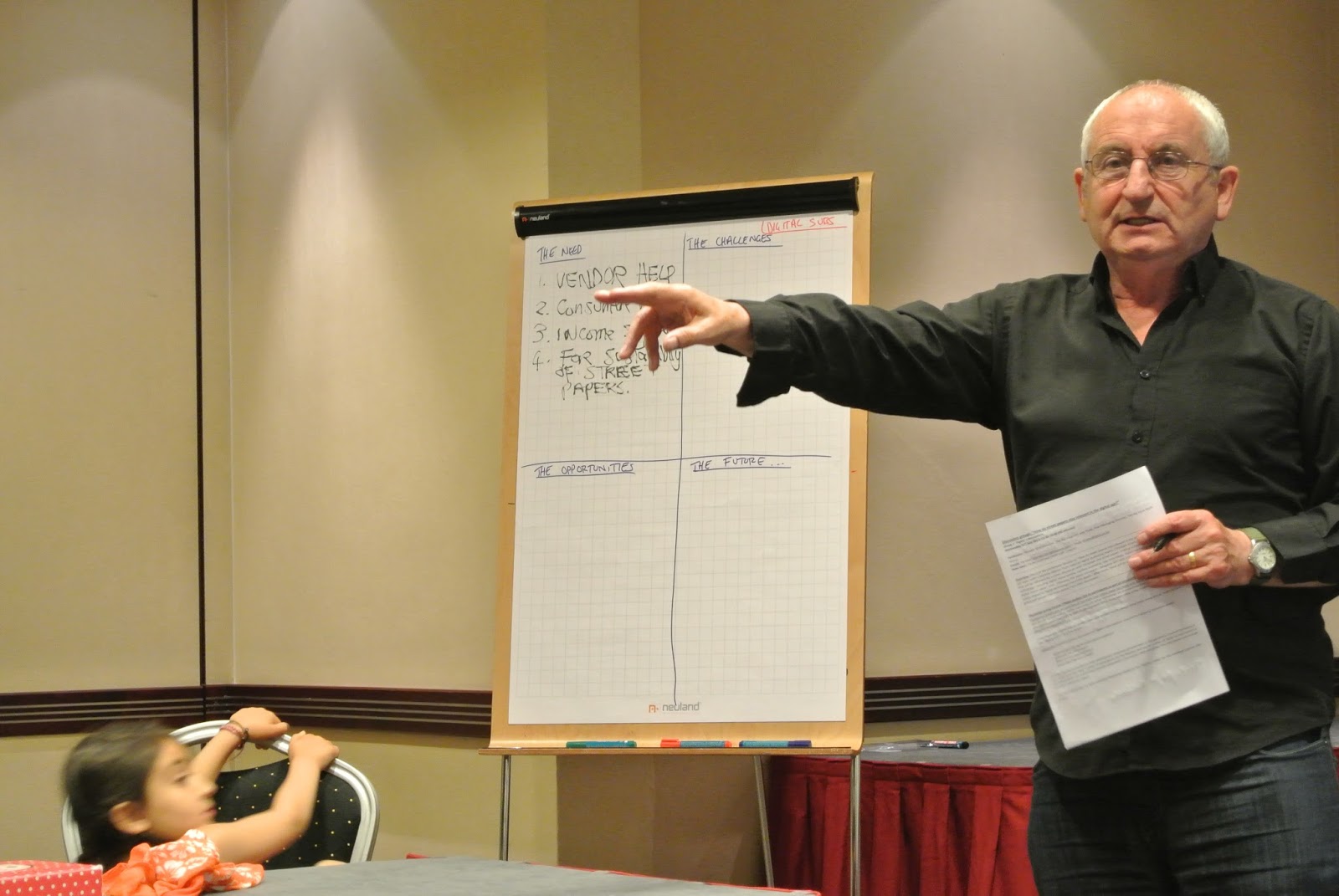 |
| John Bird (Big Issue UK) |
Since the demand for digital subscriptions seems to be underestimated in many places, there are many opportunities: tokens could be sold on the streets and vendors who either can't or do not want to sell on the streets could get an alternative chance to interact with the readers. The sky is the limit when the street papers enter the digital era and John Bird emphasized that "innovation is a bit like justice - it doesn't exist unless it can be seen being done".
 |
| Christian Lissman (BI in the North) and Steven Persson (BI Australia) |
In particular they looked at the INSP digital street paper pilot. In partnership with The Big Issue in the North, customers could get a digital copy of the popular street paper on their phone by buying a QR code card from a vendor, priced equally to the print copy so that the vendor’s income is still assured. This has since been replicated by The Big Issue Australia.
The discussion participants discussed its success and possible improvements. "A digital copy is a first step, but it's not the future," Ilse Weiss from Strassenkreuzer said.
+119.jpg) |
| Alan Attwood (BI Australia) and Fay Selvan (BI in the North). |
Fay Selvan explained: "For me the experiment with the cards was very important, because it told us: if we're selling a digital version, it has to offer much more than a simple PDF copy of the print."
Birgit Müller (Hinz&Kunzt, Germany) wants to explore the cross-media opportunities an e-paper has to offer. In her opinion the digital version has to be completely different: "We could be very unique in our electronic media. We should highlight the opportunities of digitalisation rather than shouting 'Oh, we are all dying!'"
 |
| The participants discussed the advantages and disadvantages of a digital street paper. |
Group 3 focused on the possibilities of cashless payments. With credit and debit cards being widely accepted, an increasing number of people, especially younger, potential buyers, no longer carry cash, costing vendors valuable business. Discussion leaders Amy Roe (Editor of Real Change, USA) and Brittany Langmeyer (Publisher at StreetWise, USA) looked at a pilot scheme launched by Chicago-based street paper StreetWise, in partnership with digital payment experts at PayPal, which involved customers being able to pay for the magazine by smartphone.
Other possibilities to pay without cash are via text messages (the price for the street paper is charged by your telephone company and appears on your bill) or via NFC (Near Field Communication): you pay for a product by putting your smartphone equipped with a special chip in close proximity to a reader. However, there are some challenges for electronic payment: the vendor's willingness to learn about new technologies, the fees Apple and Google charge for apps in their app stores, the fact that many vendors prefer to get their money instantly - which is not always guaranteed with cashless payment - and, last but not least, the limited battery life of smartphones.
+discussion+grop+3+003.jpg) |
| Amy Roe (Real Change) and Brittany Langmeyer (StreetWise) lead through the discussion group"cashless payment". |
Erlend D. Paxal, Manager of the paper Sorgenfri from Norway, highlighted a crucial aspect: "All those systems we talk about right now are quite complicated to use, both for the vendor and the customer. What we really need are payment options which are as easy to use as cash or even easier - otherwise we will deter customers from buying our papers".
Group 4 discussions centred on digital marketing, and the benefits that an effective social media campaign can bring. Aaron Israelson (Editor-in-Chief of Faktum, Sweden), Patricia Merkin (Director of Hecho en BsAs, Argentina) and Maree Aldam (Development Manager at INSP) looked at how street papers can reach new readers and increase sustainability at minimum cost with the use of social media and other digital marketing tools.
Swedish street paper Faktum demonstrated this in 2012 with the launch of Faktum Hotels, a website where people can ‘book’ rooms in a homeless hotel – ‘amenities’ include filthy mattresses and flattened cardboard boxes – with their booking money being donated to the paper. The campaign received widespread coverage in Sweden and around the world, increasing both the magazine’s profile and awareness about homelessness, a perfect example of how social media can be used in powerful and innovative ways.
At the end of the day's discussion session delegates from each group reported back to the conference at a feedback session, allowing other groups to hear the main points covered in each topic.
Olympic Park
 |
| At the end of conference Day 1, the delegates were invited to the world famous Olympic Park... |
The Munich landmark was built for the 1972 Olympic Games and has since become a tourist hot spot, featuring world class sports facilities, a shopping mall, and an open air cinema.
 |
| ...where they enjoyed dinner in a relaxed atmosphere. |
Over dinner the delegates continued networking, chatting about their street papers and exchanging impressions from their conference day. They enjoyed the friendly atmosphere on a perfect summer evening in Munich.
After dinner, the participants were taken to Olympic Park’s open-air Theatron where, surrounded by the amazing views of the park, there was a showing of two films created by street paper BISS. First the audience watched a short documentary about people who make their living by collecting returnable bottles that BISS used to recruit new vendors. The second film, "Hotel BISS", was shown.
Hotel BISS was a project started in 2007 by BISS to turn a former women and youth’s prison at Neudeck into a 72 room four-star hotel where 40 young people in particular social difficulty (some of them former inmates at Neudeck) would work and live while they received vocational training. The first class hotel was also to have 11 additional rooms for housing the elderly.
 |
| Hildegard Denninger (BISS, Germany) opened the showing of her movie "Hotel BISS". |
The Hotel BISS movie charted the hopeful beginnings and ultimate failure of the project. At a time when street papers are changing their model and gearing it towards social enterprise and social development (both of which are new award categories at the INSP awards at the end of the conference), the film gave delegates a lot to think and talk about.
30 July 2013
Workshop: street paper exchange
Along with networking and panel discussions, the first day of the INSP conference also featured the street paper exchange, a range of practical workshops focusing on the main areas of street paper operations.
The street paper exchange is not just for new and smaller street papers to get advice from more established operations, but also for the established members to discuss how they can continue to succeed and adapt to the changing media landscape.
The workshop is split into five groups, each focusing on different aspects of the street paper model with topics and discussion geared towards specific expertise within the industry.
Group 1 focused on social support programs and vendor support services. Led by social worker Johannes Denninger (Distribution at BISS, Germany) and National Sales Manager at The Big Issue UK, Des Sharples, the group discussed how street paper sales affect the lives of the vendors that sell them. Vendor support is at the heart of the work of street papers and the circulation of papers directly impacts the vendors’ income and personal development. The session tackled various questions from street paper distribution and pitch management to sales training, incentive schemes and other social support program.
Among the issues discussed was the challenge of vendor motivation, especially retaining vendors after they first sign up for the job. The participants agreed that incentives are the most important tool in vendor motivation. Incentives could be giving the vendors free copies of the magazines for them to sell or merchandise, such as t-shirts or hats, once they reach certain sale numbers. It was also suggested that joining forces with other projects, such as music or sports groups for the vendors, can be a motivation boost.
Group 2 was aimed at the street papers’ editorial staff, with experienced editors Alan Attwood (Editor of The Big Issue Australia) and Anlov Mathiesen (CEO and Editor-in-Chief of =Norge) leading a discussion on editorial development.
How do street papers ensure that their existing readership remains interested and that they continue to attract new readers? All delegates agreed that the front cover of their paper was the most important element in the selling process.
Bambi, Dalai Lama or politician? There were different opinions on
which cover works the best. Alan Attwood
argued: "Celebrities sell". Thomas Anthun Nielson (Megafon, Norway) described a different experience: "It's the brand that matters, not the content– I put my ex-girlfriend on the cover, just for fun!"
Delegates discussed what makes street papers unique in the media landscape and shared ideas on what kind of content street paper readers want. Alan Attwood encouraged editors to integrate the vendors' experiences and feedback into the editorial process while maintaining a high quality of content. "Once I got a wake-up call from a vendor who told me: 'You have to stop indulging yourself! I want to sell that bloody thing!'" The workshop also raised questions about the ethics and responsibilities of street papers. Is it possible, or even desirable, for street paper editors to be journalists and activists at the same time? "We don't want to be left-wing, but we are definitely activists," Birgit Müller (Hinz&Kunzt, Germany) said.
Group 3 focused on strategic partnerships and fundraising. As a result of the global economic downturn, fundraising has become increasingly difficult in many countries, as more organisations compete for a smaller pot of funds. Hildegard Denninger (Managing Director of BISS, Germany) and Patricia Merkin (Managing Director and Editor of Hecho en BsAs, Argentina) spoke of the importance of creativity in fundraising and using new tools and ideas to increase support. Sustainability of the street paper model was also at the forefront of discussion, with developing strategic partnerships to secure long term support being pointed to as a key element for sustainability. The participants shared their ideas of raising money for the street papers, such as sponsorship for the vendors to provide their employment, micro-credits or the advertisement-acquiring.
Group 4, also for fundraisers, worked on generating independent income for street papers. Amy Roe (Editor of Real Change, USA) and Gabriele Koch (INSP Director and Fundraiser at Hinz&Kunzt, Germany) were leading the discussion of how street papers can increase their income. Adjusting the price and frequency of the magazine were mentioned as possible measures, but the discussion went further: how about creating special issues that could be sold beside the magazine? Do subscriptions really need to be a taboo? And how should it all be financed?
Group members were eager to share their ideas - one delegate wanted to create a calendar, while another was thinking about cooperating with INSP and well-known musicians. Another was brainstorming on how to create "social street maps" (maps where you could find all the interesting sights in a city, thus trying to understand more of the social difficulties within). All of a sudden Arkady Tyurin from Put Domoi (Russia) silenced the room: "I would just like to remind that 'impossible' is just an opinion."
Group 5, chaired by Trudy Vlok (INSP Vice-Chair and Managing Director, The Big Issue South Africa) and Steven Persson (INSP Secretary and CEO, The Big Issue Australia), saw the more established papers with large vendor numbers discuss the challenges that they face: be it a decrease in sales, the "distant love" (Almut Maldfeld, Asphalt, Germany) which is often displayed towards street papers, or the fact that papers want to do the very best for their vendors, keeping in mind that they are businesses and not charities.
Trudy and Steven shared their business strategies and talked about how their papers turned into success stories. According to them, building relationships is crucial, as well as having a good distribution network and maximizing your brand (the street paper). In the end, Fay Selvan, Group Chief Executive from The Big Issue in the North (UK), concluded: "The open-minded and can-do-attitude was very nice, as well as the numerous stimulating ideas provided by the speakers. I take away from the workshop that you should always look forward and not to get stuck by what went wrong in the past."
The street paper exchange is not just for new and smaller street papers to get advice from more established operations, but also for the established members to discuss how they can continue to succeed and adapt to the changing media landscape.
The workshop is split into five groups, each focusing on different aspects of the street paper model with topics and discussion geared towards specific expertise within the industry.
 |
| Workshop 1: support programs and vendor support services. |
Among the issues discussed was the challenge of vendor motivation, especially retaining vendors after they first sign up for the job. The participants agreed that incentives are the most important tool in vendor motivation. Incentives could be giving the vendors free copies of the magazines for them to sell or merchandise, such as t-shirts or hats, once they reach certain sale numbers. It was also suggested that joining forces with other projects, such as music or sports groups for the vendors, can be a motivation boost.
Group 2 was aimed at the street papers’ editorial staff, with experienced editors Alan Attwood (Editor of The Big Issue Australia) and Anlov Mathiesen (CEO and Editor-in-Chief of =Norge) leading a discussion on editorial development.
 |
| Workshop 2: Lead by Alan Attwood (The Big Issue Australia) and Anlov Mathiesen (=Norge, Norway) |
 |
| Workshop 2: Editorial development. |
Delegates discussed what makes street papers unique in the media landscape and shared ideas on what kind of content street paper readers want. Alan Attwood encouraged editors to integrate the vendors' experiences and feedback into the editorial process while maintaining a high quality of content. "Once I got a wake-up call from a vendor who told me: 'You have to stop indulging yourself! I want to sell that bloody thing!'" The workshop also raised questions about the ethics and responsibilities of street papers. Is it possible, or even desirable, for street paper editors to be journalists and activists at the same time? "We don't want to be left-wing, but we are definitely activists," Birgit Müller (Hinz&Kunzt, Germany) said.
 |
| Leaders of workshop 3: Patricia Merkin (Hecho en Bs As, Argentina) and Hildegrad Denninger (BISS, Germany) |
 |
| Workshop 4: Generating our own income. |
 |
| Leaders of workshop 4: Amy Roe (Real Change, USA) and Gabi Koch (Hinz&Kunzt, Germany) |
Group 5, chaired by Trudy Vlok (INSP Vice-Chair and Managing Director, The Big Issue South Africa) and Steven Persson (INSP Secretary and CEO, The Big Issue Australia), saw the more established papers with large vendor numbers discuss the challenges that they face: be it a decrease in sales, the "distant love" (Almut Maldfeld, Asphalt, Germany) which is often displayed towards street papers, or the fact that papers want to do the very best for their vendors, keeping in mind that they are businesses and not charities.
Trudy and Steven shared their business strategies and talked about how their papers turned into success stories. According to them, building relationships is crucial, as well as having a good distribution network and maximizing your brand (the street paper). In the end, Fay Selvan, Group Chief Executive from The Big Issue in the North (UK), concluded: "The open-minded and can-do-attitude was very nice, as well as the numerous stimulating ideas provided by the speakers. I take away from the workshop that you should always look forward and not to get stuck by what went wrong in the past."
Day 1 round up: staying relevant in a changing world
 |
| MC Wim de Preter kicking off Day 1. |
Serge Lareault (Chairperson of INSP and Executive Director of L’Itinéraire), Lisa Maclean (Executive Director of INSP) and Hildegard Denninger (Managing Director of host street paper, BISS) opened day one of the conference, this year held in Munich, and welcomed delegates from street papers all over the world.
 |
| INSP and BISS welcome the delegates. |
"I hope you get some new ideas," Serge Lareault tells the delegates.
 |
| Street papers exchange. |
 |
| Speed-networking. |
After a quick break, and another chance to show off papers and campaign materials, the first of the conference’s external speakers, Rolf Pfleiderer of TNS Infratest, presented the findings of a survey of street papers in Germany.
Rolf has worked for TNS Infratest, a leading market research company based in Munich, for over 30 years and is currently Director of Media Research. The findings of the survey, conducted earlier this year over 12 cities, helped to give delegates an insightful overview of the street paper context in Germany.
 |
| Panel discussion. |
Following this was a panel discussion surrounding the day’s central theme: “how do street papers stay relevant in the 21st century?”
Panellists Steven Persson (The Big Issue Australia), Amy Roe (Real Change, USA), Anlov Mathiesen (=Norge, Norway), Hildegard Denninger (BISS, Germany), and speaker Rolf Pfleiderer, chaired by Editor of The Big issue Australia, Alan Attwood, discussed this question. A selection of street papers that have developed innovative approaches to try to ensure that their street paper stays also featured in the discussion.
Participants of the discussion agreed that street papers will continue being relevant. Hildegard Denninger (BISS) is convinced: "Our work has always been very relevant. I'v worked in the normal economics for about twenty years before - and I've never felt doing something more relevant than the street papers." The role of street papers is quite different from the one of mainstream newspapers. Amy Roe (Real Change, USA) underlined that "street papers cover news, although not breaking news." Hildegard agreed that the job of street papers is to provide background stories which deepen your understanding.
 |
| Over 100 delegates from all over the world participate at this year's INSP conference. |
The first day of the conference also featured the Annual General Meeting. Along with welcoming new members to the network from 2012-13 the meeting also saw INSP Executive Director, Lisa Maclean, give the annual review of the network and a presentation on the future strategies of INSP, outlining its new business plan for 2013-15.
She said: “With some street papers reaching their 20th birthday in 2012, we have seen a general recognition that it is a time to update our business model; we have to look at ways to be more sustainable, more innovative and enterprising. We need to continue working to engage more with our existing readers and supporters and engage with new groups.”
This year the new award categories for social enterprise and social development reflect the changing street paper model.
Subscribe to:
Posts (Atom)