Showing posts with label INSP. Show all posts

16 April 2015

Real Change launches cashless payment app with Google


By Laura Kelly

Seattle street paper Real Change has partnered with tech giant Google to launch an app that allows customers to pay for their paper digitally and have it delivered straight to their phones.

Vendors have had increasingly difficulties selling the paper, since fewer and fewer people carry cash with them, said Timothy Harris, founding director of Real Change.

“Cashlessness is a challenge our vendors face on a daily basis,” he added. “This app will help our paper survive in the digital age, when fewer people have ready access to cash and more people prefer to read news content on their mobile devices.”

From today, each of Real Change’s homeless and low-income vendors will each get a unique QR code on their vests to allow them to sell digital versions of the award-winning street paper, as well as the usual paper copies.

After downloading the free app to their iOS or Android phone, Seattleites will be able to scan their local vendor’s unique code to buy their digital paper for $2.99 (including a fee from digital content providers)

Vendors will make $1.49 every time someone buys a digital copy of Real Change, whilst they will still get $1.40 from every paper copy they sell. The paper copy will still cost $2.

“We designed this with our vendors and customers in mind,” said Harris. “This app will build on the strong relationships our vendors have with many of their customers, while helping customers benefit from an increasingly seamless buying experience. The paper is just a scan away.”

The project was started two years ago by a Google employee who volunteered at Real Change as part of Google’s annual week of service. 

Since then, eight Googlers have volunteered their time to develop the cross-platform app, the first of its kind for the paper.
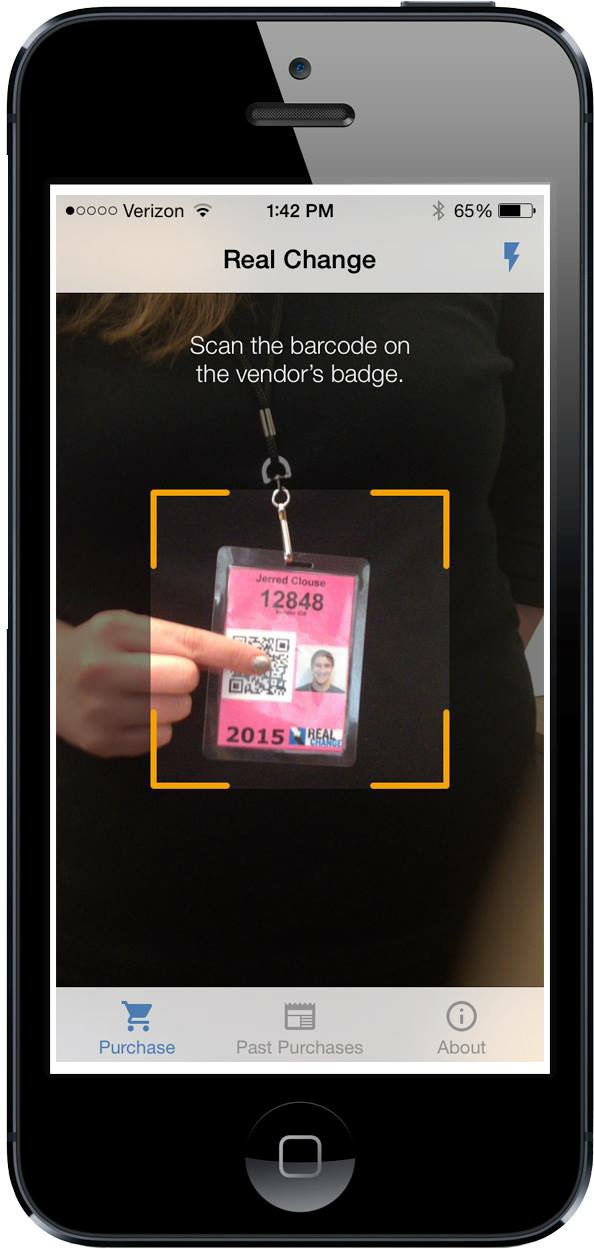
The app in action.
“Being on the volunteer app development team has been a gratifying experience,” said Jill Woelfer, a Google User Experience Researcher who has been volunteering with Real Change since early 2014. 

“The whole team has worked very hard to create a technical solution to provide opportunities for those who are in need.”

“Street newspapers around the world are looking for a solution to how they can better adapt to the changing media landscape, while still staying true to the signature street paper model,” added Darcy Nothnagle, Public Affairs Manager for Google. 

“We hope that this app will be a model many street papers can use, globally.”

Real Change’s app is just one of the pioneering digital adaptations coming from INSP’s members. 

Others include Chicago-based StreetWise’s partnership with PayPal and The Big Issue South Africa’s SmartBibs, both of which also allow customers to pay online using their phones.

In Europe, Amsterdam’s Z! magazine and Scandinavian papers =Norge, Situation Sthlm and Faktum are working on pilot projects to provide vendors with card readers, so that customers can pay with debit or credit cards. 

In addition, some papers, including Situation Sthlm and Norway’s =Norge, use payments through text messages. 

“Many of INSP's 114 street papers, in 35 countries, are facing issues based on the continuing march of our cashless society,” said INSP chief executive Maree Aldam. 

“Innovative solutions such as Real Change’s app show how dynamic street paper organisations can continue to provide employment to some of the most vulnerable people in society, despite the new challenges they face.”

13 March 2015

10 reasons not to miss #INSP2015

Last week, INSP's Zoe Greenfield was in Seattle preparing for INSPired Together: Global Street Paper Summit 2015. She told us why street paper staff would be mad to miss it...

1.    It’s INSP’s first US event
It’ll be fantastic to have street papers from all over the world (familiar faces, and new ones too!) representing our truly global network. We already know we’ll have delegates from at least 20 different countries.

2.    Global perspective, local context
As an international network we’re facing some common challenges, especially those resulting from the economic downturn which hit those already on the margins hardest. But it’s also important to understand the different socio-economic, political and cultural contexts in which we are working.

We’re in the fortunate position to be able to draw on each other’s expertise and learn about those more local challenges too. In the words of Real Change’s Tim Harris:

“Our diversity is our strength, and that what we have in common trumps our differences… we are all in this together, learning from each other, healing a broken world, one vendor and one newspaper at a time.”

Couldn’t have put it better myself!

3.    Seattle streets
A recent one night count found almost 4,000 people without shelter in King County.  Homelessness is very visible in Seattle. Life is tough here; there is no safety net. Even as someone who has travelled widely and worked with lots of homeless organisations, I have so many questions about homelessness in Seattle.

It’s a city with issues but it’s also a city that is responding to the challenge. In June, we’ll learn about homelessness in the city and about the response. You’ll have the option to visit innovative social projects like Urban Rest Stop, 1811 Eastlake, and one of Seattle’s self-managed tent encampments. We’ll also enjoy dinner at a social enterprise restaurant Farestart which offers training and employment opportunities to homeless and unemployed people (not to mention delicious food and great service).

4.    And of course, our very own Real Change
It’s well known and very well respected in Seattle. Many people I met credit Real Change with bringing about a city-wide shift in attitudes towards homelessness. Go RC!

I received a very warm welcome from staff, volunteers and vendors (you’re awesome) to the Real Change office in the Pioneer Square district. You’ll have the chance to visit when Real Change host an open house (Tuesday 23 June).

5.    People are talking
From local radio to conversations on the bus, people in Seattle are talking about homelessness and social justice issues.

Read articles and listen to KUOW podcasts as part of the recent ‘Seattle homelessness’ series.


6.    There’s already a buzz
And (the abbreviated version) sounds something like this:
Person hearing about the Global Street Paper Summit: “I love Real Change. Do you work for Real Change?”
Me: “No, I’m visiting Real Change.  I work for INSP.”
Person: “Wait, so Real Change isn’t the only one?”
Me: “No, there are 114 street papers in 35 countries and they’re coming to Seattle in June.”
Person: “Wow. That’s awesome!”
Me (in my head): “Damn right, it’s awesome!”

And here’s our street: (Global Street Paper) Summit Avenue.
 

7.    Make your own
A bit like a pizza, INSP will provide the base and you can load up on your favourite toppings. Basically, there’ll be some INSPirational keynote sessions and you get to decide which breakout sessions you want to attend. Never fear, the old favourites including Innovation Exchange will be back. We listened to your feedback so there’ll be more sessions on fundraising, marketing and social media too.

8.    Celebrate in style
The INSP Awards are back! Get your glad rags (or traditional dress of your home country) on and shimmy on down to the ballroom to celebrate the journalism and social impact of our incredible network.

9.    Good to great
We already know our work has an impact (see point no. 8) but it’s useful to stop and ask ‘how can we take this to the next level?’ Altruist Partners will help us to think about what might be holding us back and how we can become more enterprising to scale up and maximise our impact.

10.    Rock’n’roll
Just when you thought it wasn’t possible for INSP to get any cooler, we decide to end the Summit on a high with a benefit gig at Seattle’s famous Crocodile Club. Between you and me, I’m sure we won’t wait until Friday to explore the local nightlife...

Can’t wait to see you in Seattle! 


30 January 2015

"The Big Issue, no matter where you buy it, is a magazine like no other"

To mark international #VendorWeek, Melissa Cranenburgh, Associate Editor of The Big Issue Australia, writes about the importance of the street paper movement, what she learned on a visit to Big Issue offices in Japan and why we celebrate our vendors.

As our new edition of The Big Issue Australia is distributed, we begin a global event dedicated to the person who sold it to you – and many others in similar circumstances around the world.
The Big Issue in Australia's latest cover.

From 2-6 February, the INSP #VendorWeek  acknowledges the approximately 14,000 vendors who sell street magazines in 600-odd cities around the world. A reminder that whether you’re in Brisbane or Belgrade, Oslo or Osaka, you can find something really worth reading – a far-from cheesy souvenir – that directly contributes to those who need it most.

About a year after I started working at The Big Issue  in Australia, I went on a trip to Japan. It was a strange time to travel as an Australian – to be suddenly flush with a newly generous exchange rate, after the global financial crisis had pushed most other places into recession. As a Japanophile, it was far from my first trip to the land of pachinko machines and superlatively good manners; but on this visit there were cracks starting to show on the well-tended surface, large enough for even a foreigner to see.

There was a growing air of (very) polite rebelliousness creeping into even casual conversations. Many in their prime working years had been suddenly turfed out of what they had assumed would be lifetime careers. Those who’d had a good education, family support and the means, had tried to turn this into a small boon. International travel beckoned; creative pursuits filled the void left by more challenging work. But for those who had been barely clinging to the slipperiest part of the slope, the sudden tip in finances were enough to land them, rather brutally, onto the streets.

Pic: The Big Issue Japan.
Nowhere was this more apparent than at the local Big Issue offices, which I was lucky enough to visit. Our benevolent franchise had landed in Japan and taken root in 2003, quickly becoming something unique to that place.

It had quirkily Japanese content – the most widely sold edition at that time was one where a food writer had based recipes on the ‘ask a vendor’ agony aunt column – and the local vendor support workers increasingly acted as a valuable basic service to those suddenly locked out in the cold. Helping some to know their rights to unemployment benefits, to fill in forms, to find some kind of accommodation.

Many of those who sold The Big Issue in Japan slept rough on the streets and it was common to see vendors, neatly dressed, wheeling compact suitcases into the vendor offices – each bag containing all their worldly belongings. As it had in other parts of the world, Japan’s Big Issue had adapted to suit the political climate and needs of the vendors, as much as the taste of its readers. Filling in the gaps left where the government had failed.


While it should always be part of any national agenda to build a society that doesn’t leave anyone behind, increasingly – all over the world – it’s fallen to those outside of government to find solutions to the people left on the margins. The international street paper movement fits into that category. Some would call it a Social Enterprise; others…well, they might quibble semantics.

One thing’s for sure: there’s a growing mood of dissatisfaction with the state of inequity growing around the world, and a need to do something sustainable to bridge the growing divide.

Just remember as you thank your vendor, and flick through the pages: The Big Issue [and other street papers like it], no matter where you buy it, is a magazine like no other.

This #VendorWeek, The Big Issue Australia will once again run their CEO Selling fundraising campaign, in which 100 business leaders and politicians will don a fluorescent bib and try their hand at selling the street paper.

23 January 2015

Philadelphia pizzeria feeds homeless one slice at a time

By Laura Smith

A dollar-a-slice pizza shop in Philadelphia has encouraged its customers to give over 9,000 free slices of pizza to the homeless.

Rosa’s Fresh Pizza owner, Mason Wartman, started up a Pay It Forward scheme in March 2013 after a customer asked if they could buy an extra slice for someone in need. 

Since then, Rosa's has let customers pre-pay for a slice of pizza, which a homeless person can then order to take away or eat in store.

Mason says Rosa's now serves around 40 homeless people every day, and that his customers have generously bought close to 9,500 pizza slices in the past 10 months.

"My customers love the opportunity to help out," the 27-year-old told INSP. 

"The homeless people really use the program as a flexible way to get access to food. One Monday, a homeless customer said that because we were closed on a Sunday, they hadn’t ate anything since Saturday. That blew my mind."

After his first customer asked to have an extra slice of pizza given to the hungry, Mason says he wrote a smiley face on a Post-It note and stuck it up on one of the walls of his shop.

Today, a sea of neon Post-Its bearing messages from people who have done the same are plastered all over Rosa's.

Among them are heartfelt messages from those who have come in for a free slice of pizza.

A message written on a paper plate by Rob H, a homeless veteran who often visits Rosa's, reads: "God bless you, because of you I ate off this plate. It's the only thing I ate all day. I am a homeless veteran and get treated rudely when I ask for help. Rosa's treats me with respect."

Another homeless customer writes: "I've been homeless in Philly for six years and I'm so happy to see people coming together and really making a difference in the community. Rosa's is a great start to changing the way homeless people are treated. God bless you all."

While Mason didn't necessarily set out to feed roughly 1% of Philadelphia's homeless every day, the business owner is thrilled at what Rosa's Pay It Forward pizza scheme has achieved.
Glen models his new Rosa's sweatshirt.

"Homelessness is a visible pervasive problem in Philadelphia," adds Mason. "It’s important for Rosa’s to be extremely good at something and use this to improve the community. Feeding the homeless like we do is the best way we can use our talents as a company."

As well as providing homeless people with some comfort food, Rosa's is now clothing them too and pointing them in the direction of homeless services.

Mason has started selling t-shirts with the help of clothing company, Rush Order Tees, and donates 50% - the equivalent of seven slices of pizza - for every sale.

Also on offer are sweatshirts. For every one purchased, another sweatshirt is donated to the homeless and has a large tag sewn on the inside that details homeless resources in the city.

Mason explains: "On the inside of the sweatshirt there is a tag of information the homeless person can use: phone numbers and locations for shelters, meals and computer classes. Hopefully this will encourage the homeless person to structure their day productively, acquire durable skills and improve their lives.

"It’s one of the most exciting things I’ve worked on."


You can find out more by visiting the Rosa's Fresh Pizza Facebook page

21 January 2015

Top names join INSP #VendorWeek Big Sell

The #VendorWeek Big Sell is gaining momentum as big names sign up for the fundraising event at the heart of INSP’s #VendorWeek celebrations.

From 2-8 February, street papers in the UK, Australia, America, Denmark, Switzerland and Greece will hold guest vendor events as part of the #VendorWeek Big Sell.

In the UK, guest vendors will sell The Big Issue and The Big Issue in the North for an hour in a sponsored challenge to raise money for INSP’s work.

Below is a full list of the 72 guest vendors who have signed up for the UK so far. We'll be adding sponsorship pages as they are available.

To sponsor your favourite guest vendor follow the links below. 

Don't know who to sponsor? Support the full team here.


Monday 2 February

London:
Fraser Nelson, Editor, The Spectator
Colin Murray, BBC sports and music presenter
Paul McNamee, Editor, The Big Issue
Dominic Laurie, BBC Business presenter
Julian Lloyd-Evans, MD Advertising, Dennis Publishing
Brendan O'Neill, Editor, Spiked
David Wilding, Director of Planning, Twitter UK

Sheffield:
Ian McMillan, poet
Tony Stacey, CEO of social landlord Syorksha

Manchester:
Kate Green MP (Labour)

Tuesday 3 February

Manchester:
Ian Munro, chief executive at New Charter Housing in Tameside
Bishop David Walker, Bishop of Manchester


Wednesday 4 February

Glasgow:

11am-12pm:
Richard Walker, Editor, The Sunday Herald & The National
Tony Carlin, Editor, The Evening Times
Marie Macklin, CEO, The Klin Group

12pm-1pm:
Twin Atlantic (whole band)
Garry Sweeney, Gabriel Brodie in River City
Adam Robertson, Dr Dan Hunter, River City

1pm-2pm:
Lauren Mayberry, Chvrches singer
Moray McDonald, MD, Weber Shandwick
Andrew Bartlett CEO; & Ruth Kelso Head of Learning & Development, Social Enterprise Direct
Colin Stone, reporter STV
Ruth Kelso, Head of Learning and Development at Social Enterprise Direct

2pm-3pm:
Stuart Braithwaite, Mogwai
Janey Godley, comedian
James Graham, Twilight Sad singer

3pm-4pm
Robert Florence and Iain Connell, comedians and Burnistoun stars
Robin McAlpine, Common Weal 
Fiona Godsman, ‎CEO, Scottish Institute for Enterprise
Ross McCulloch, Director, Third Sector Lab

Edinburgh:
9am:
Nikki Simpson, PPA Scotland
Alison Johnstone MSP (Green)

Manchester:
Allan Beswick, BBC Radio Manchester
Mike Burrows, Managing Director of Greater Manchester Academic Health Science Network
Dave Power, Chief Executive of City South Manchester Housing Trust
David Herne, Acting Director of Public Health, NHS Salford

Leeds:
Mark Burns-Williams, West Yorkshire Police & Crime Commissioner

Liverpool:
Keith Mullin, The Farm
Ann O'Byrne, Labour Councillor
Dan Haggis, The Wombats

Thursday 5 February

London:
Kay Burley, Presenter, Sky News

Edinburgh:

9.30am:
Ewan Stark, Managing Director of S1

11am-12pm:
The View, band
Rt Rev John Chalmers, Moderator, Church of Scotland
Robert Carroll, Managing Director of MOV8 Real Estate
Niall Patterson, Chief Executive Abbeyfield Scotland
Lloyd Anderson Director, British Council Scotland

Edinburgh (near Scottish Parliament): 1pm-2pm:
Jackie Baillie MSP (Scottish Labour)
Margaret Burgess MSP (SNP) - Minister for Housing & Welfare
Christina McKelvie MSP (SNP)


2pm-3pm:
Sarah Boyack MSP (Scottish Labour)
Josh Littlejohn, Director Social Bite
Mike MacKenzie MSP (SNP)

3pm-4pm:
Johann Lamont MSP (Scottish Labour)
Angus MacDonald MSP (SNP)

Manchester:
Matthew Gardiner, CEO of THT

Friday 6 February

Sheffield:
David Blunkett MP (Labour)
Paul Blomfield MP (Labour)

Bradford:
Harry Leslie Smith, survivor of the Great Depression, RAF veteran & activist

Horsforth:
Stuart Andrew MP (Conservative)

Barnsley:
Alan Billings, PCC   

Leeds:
Stuart Andrew MP (Conservative)
Hilary Benn MP (Labour)

Liverpool:
Maria Eagle MP (Labour)


Saturday 7 February


Bradford:
George Galloway MP

For more information about the #VendorWeek Big Sell, please contact Laura Dunlop: l.dunlop@street-papers.org / 0141 302 6554

14 January 2015

How street papers are celebrating #VendorWeek2015

In the first week in February, street papers around the world will take part in #VendorWeek, a huge celebration of street paper vendors that also challenges perceptions of poverty and homelessness.

#VendorWeek 2015 takes place 2-8 February with an international programme of events, activities and social media action planned by street papers in the UK, America, Canada, Europe and Australia.

Guest vendor events

The #VendorWeek Big Sell is INSP's flagship fundraising event during February. It sees
high profile people take on the challenge of selling a street paper, mentored by one of the paper's hardworking regular vendors.

In partnership with INSP, The Big Issue UK and The Big Issue in the North will hold #VendorWeek Big Sell fundraising events in London, Glasgow, Edinburgh and Manchester.

The Big Issue Australia will once again run their CEO Selling campaign, in which 100 business leaders and politicians take up the street paper selling challenge.

Similar #VendorWeek Big Sell events are also being planned by Greece's first street paper Shedia in Athens, Hus Forbi in Denmark, Washington DC's Street Sense, One step Away in Philadelphia and Swiss publication Surprise in Basel, Bern and Zurich.

One Warm Winter

German street paper Strassenfeger will once again run their 'One Warm Winter' campaign to coincide with #VendorWeek. The fundraising drive asks the public to donate money to supply warm winter clothes for the Berlin's street paper vendors and culminates in a party for vendors.

Vendor events

Many vendor-focused events are also being organised to mark #VendorWeek. Austrian street paper Kupfermuckn will hold a portrait painting workshop exclusively for vendors to help them unleash their creativity. Afterwards, they will be treated to a party with music, food and drink.


To reward their vendors for all their hard work, American paper Homeward Street Journal are giving each of their vendors a free bundle of papers, which they would usually pay for at a discounted rate, to sell during #VendorWeek so they can earn more money.

A special Skype call to connect vendors in America and Canada is also being planned by Street Roots in Portland, Oregon and Vancouver street paper Megaphone.

Vendors and staff of Quebec street paper L’Itinéraire are planning a special promotional event during which they will read the magazine out loud in Montreal's subway cars. Vendors will also denounce austerity measures taken by the Quebec government with silent protests in different subway stations.

Social Media

INSP is leading the way to promote the event on Twitter and Facebook using #VendorWeek. This includes a mass tweet to celebrate street paper vendors around the world on 2 February, using crowdspeaking network Thunderclap. Everyone can join in here.
Many of our member street papers also plan to harness the power of social media during #VendorWeek. Street Roots will tell the story of the street paper movement through Twitter, Instagram and Facebook by sharing images and quotes from street paper vendors worldwide.

Macedonian street paper Lice v lice will share stories about their most successful vendors on their website and via social media.

Zeitschrift der Straße, a street paper based in the German city of Bremen, will use its blog and Facebook to share daily posts about international street paper magazines throughout #VendorWeek 2015.

#VendorWeek 2015 takes place takes place 2-8 February. Keep up to date by following @_INSP on Twitter and #VendorWeek.

18 December 2014

Revolutionise: 15 tips for 2015

By Zoe Greenfield

Earlier this month, I attended the Revolutionise Annual Lectures in London. The second event of its kind, it saw 18 speakers share their philanthropy and leadership insight and expertise. The Revolutionise team compiled a Storify of delegate tweets which captures many of the themes and conversations from the day. I’ve gathered some personal reflections in my 15 for 2015 list:

1.    Be ambitious

B.H.A.G it! What is your ‘Big Hairy Audacious Goal’? Whatever your mission (to help more children, save more lives, find a cure faster), be ambitious! 

"A true BHAG is clear and compelling, serves as unifying focal point of effort, and acts as a clear catalyst for team spirit. It has a clear finish line, so the organization can know when it has achieved the goal; people like to shoot for finish lines." - Collins and Porras

2.    Challenge yourself

3.    Never miss an opportunity

Be ahead. Be bold. Be positive. Be innovative.

4.    Science is cool

In his keynote address, Phil Barden of Decode Marketing explained how we can take the principles of science and leverage them in our communications. Science can help us to understand decision-making and what drives us, as shown in the Decode Goal Model (pictured).

Interested in finding out more?  To receive regular updates on behavioural economics, psychology and neuroscience and their implications for marketing and communications, sign up to Decode Marketing’s Science Update.

Some light reading for the Christmas holidays:
-    Decoded: The Science Behind What We Buy by Phil Barden
-    Thinking, Fast and Slow by Daniel Kahneman
-    Lots of talk about the Chimp! I’ll be trying to tame mine by reading The Chimp Paradox by Prof. Steve Peters

5.    Tangibility

Did you know that autopilot is the preferred state of the brain? And, autopilot responds to rewards that are tangible. So if the brain responds to tangible reward, how tangible is your cause?

A recent high-impact example of tangible cause-fundraising in the UK is The Tower of London Remembers [pictured left]. This week, Social Bite (an Edinburgh and Glasgow based social business) is running a simple but highly effective campaign: £5 buys Christmas dinner for a person who is homeless. 22,000 bought and counting…

6.    Why?

As organisations, our ‘Why?’ is our mission. But donors have a ‘Why?’ too. We need to give people an opportunity to connect their values with action. This is the point where the two ‘Whys?’ meet.

7.    Tie money to the mission

We need to be better at linking our fundraising to the cause.


8.    Don’t apologise

Jeremy Hughes, Chief Executive of Alzheimer’s Society spoke passionately about fundraising’s core role within any organisation but called for a change in attitude (both internally and externally). Why is it hidden down a list? Or not even mentioned at all! Why aren't we telling people how much we need to raise instead of being apologetic about it? Without the money we couldn't do anything!

9.    Tackling some of the myths

People are right to be suspicious and to ask questions. We should want donors who are engaged enough to ask us challenging questions!

I recently started reading The Great Charity Scandal and was filled with rage. Not at the accusations made against charities but the potential damage such an attack will have on public perception of charity and consequently the amount of money people give to good causes.

Case in point: overheads. Hughes suggests that it is disingenuous to say ‘100% goes to the cause’. We should be worried about such claims; it is simply not possible to run an organisation with zero overheads.

10.    Giving: more than money

Tony Elischer declared the traditional and somewhat narrow view of giving redundant. The idea that the only ways to give are time, money and goods needs to be expanded to include voice, influence and lifestyle change.
We also need to consider reciprocity in giving, said Ken Burnett. As organisations we need to give the right things to our donors (customer services, stories) to make them want to continue their support and more importantly, spread the word.

11.    Make noise


12.    Be disruptive

It is hard to get noticed! You have to be different to grab attention, said Richard Taylor of CRUK who highlighted a shock campaign by the Pillion Trust #FuckthePoor (watch the video here) to show the lengths to which some organisations have gone to get noticed. In a similar way, we must embrace new and innovative ways of fundraising such as crowdfunding and digital.


13.    It’s OK to be angry.

Iain MacAndrew of the Cystic Fibrosis Trust talked about bringing the anger back into the organization through their 50th Anniversary ‘No Party’ campaign. After all, why should they celebrate their 50th anniversary when so many of their client group die long before that?


14.    Profit with purpose

There is a constant rumbling about the need for charities to be, or act, more corporate. But, if that were true, why are companies trying to be more like us? Business should serve society too: “Winning alone is not enough, it's about winning with purpose.” Paul Polman, CEO, Unilever.

Jacob Rolin asked why we as a sector define ourselves as something we are not and advocates a more positive definition: “Be prepared to lead the change... deliver a purpose.”

A phrase which came up many times throughout the day: profit-with-purpose. Charities shouldn’t shy away from talking in terms of profit (money left over after your expenditure) because it is this money which allows us to make change.  

15.    Be social

Times change. We need to embrace all things digital. Happy (digital) Christmas! Click here to watch a short video.

**All of the ideas, images and links came from the #AnnualLectures. I have tried to give credit where possible but after a 4am start and 15 pages of notes, my mind was abuzz and this was the most sense I could make of my notes after a day of frantic note-taking and talks jam-packed with ideas and insight. Thank you to all of the speakers! See you in 2015!**

26 November 2014

Fay Selvan named as new INSP Chair

Award-winning social entrepreneur Fay Selvan (left) has been appointed as the new Chair of INSP.

Fay will lead the INSP Board as they work closely with the Chief Executive to form the strategic direction of the organisation. She has been on the Board since August 2013.

As Chief Executive of The Big Life group, Fay leads the organisation that publishes The Big Issue in the North – one of the INSP’s two UK street papers, alongside The Big Issue.

Set up in 2002, The Big Life group works across the north of England to deliver a range of services and opportunities to the area’s most excluded people. As well as producing The Big Issue in the North, it also provides primary care and mental health services, family intervention, childcare, schools, employment and supported housing. Fay won the Social Enterprise Leader Award in 2011.

Fay said: “I am really honoured to take on the role of Chair and look forward to working with colleagues at INSP over the next few years.”

Fay takes over from Canadian street paper veteran Serge Lareault, who has been INSP Chair since 2006. Serge left Montréal’s L’Itinéraire in July, after 20 years with the street paper, latterly serving as CEO.

He will continue to support the street paper movement as Honorary President of INSP, taking over from former Editor-in-Chief of Reuters News, David Schlesinger. David Schlesinger will continue to support INSP through his role on the advisory board.

Serge said: “I am very proud of our accomplishments at INSP over the last eight years. Fay Selvan will continue this development work brilliantly and I will be happy, as Honorary President, to continue to support our street papers and our movement.”

Maree Aldam, INSP Chief Executive said: “We are very happy to welcome Fay Selvan as INSP’s new Chair.

“Working with Fay, INSP will continue to support and develop street papers around the world and to champion social business as a practical and powerful way to address homelessness and poverty.

“We are currently working towards our two major annual events: #VendorWeek, our global celebration of street paper sellers, which takes place from 2-8 February; and our annual conference, which will bring together street paper experts in Seattle in June next year.

“We also continue to run INSP’s unique News Service, which shares content produced by our network and our in-house team to strengthen the content of worldwide street papers.

“The entire INSP team and network would like to offer a huge thank you to Serge for his inspirational leadership of INSP. We have been very lucky to have him.

“We would also like to thank David Schlesinger for his valuable support for INSP.”

11 November 2014

INSP co-founder Mel Young becomes Ashoka Fellow

Chile Men's team win Homeless World Cup.
Photo: Elaine Livingstone

INSP and Big Issue in Scotland co-founder Mel Young has been elected to the prestigious position of Ashoka Fellow.

Ashoka is the world’s largest network of social entrepreneurs. Nearly 3,000 Ashoka Fellows in 70 countries are currently putting their system-changing ideas into practice on a global scale.

Young was nominated for the prestigious position by thanks to his ongoing innovative work on the Homeless World Cup.

First dreamed up at the INSP conference in Cape Town in 2001, the Homeless World Cup uses the universal language of football to bring together homeless people from around the world each year for a tournament that breaks down barriers and smashes stereotypes.

Mel Young & Dominicus Hangara
Photo: Danielle Batist
It uses the power of football to energise homeless people so they can change their own lives.

The first event in 2003 saw 17 countries compete, sourcing teams from wherever they could.

Now, Young works with partners in 73 countries across a network that has initiated, supported and catalysed a wave of professionalised homeless leagues around the world. Finalists are then selected to represent their countries.

Through these many partners, the lives of some 250,000 homeless football players are touched each year.

This year’s tournament was held in Santiago, Chile in October and saw 432 players come together for an exciting week-long tournament. Both the women’s and men’s competitions were eventually won by the home nation.


27 October 2014

8 fundraising lessons: what can we learn from patterned bread and a Star Trek wannabe?

By Zoe Greenfield

Last week I attended the Institute of Fundraising Scottish Conference 2014 in Glasgow. This was an interesting role reversal for me, as I organise INSP’s annual conference.

The ambitious programme over two days covered five themes: management and strategy; individual giving; community and events; corporate and trusts; and marketing and communications.

First class content meant delegates, especially those working as sole fundraisers, were spoilt for choice! Here are some of my personal aha! moments.

1.    Strand strong, together
There is a rising gap between rich and poor and there needs to be more recognition that this inequality hurts and weakens society, not just those directly experiencing poverty in any of its guises. 

Martin Sime, Chief Executive of SCVO warned of a campaign to undermine public perception of charities: “If such attacks continue they risk undermining public trust in charities which will make it more difficult to raise money for good causes.”

Sime went on to argue that such attacks were a deliberate attempt to silence charities that criticise or challenge the status quo.  Many organisations have campaigning for social justice and giving a voice to the poor and marginalised at their core. We have a responsibility as a sector to protect and promote this.


2.    Paradox 


3.    #proudtobeafundraiser
Sometimes fundraising is treated as a taboo, a dirty word, down played and not acknowledged as a core activity within our organisations.

Fundraising should be integral to the mission of any charity.

Charities all over Scotland (and the world!) are doing great work, but without fundraising this simply would not be possible: “Unrestricted funds are SUPERCASH and they unlock the creativity of our organisations to respond to problems in society.” Martin Sime, SCVO

4.    Pareto Principle
“The Pareto principle (also known as the 80–20 rule, the law of the vital few, and the principle of factor sparsity) states that, for many events, roughly 80% of the effects come from 20% of the causes.” - Wikipedia

So what exactly does this have to do with fundraising? ‘Major Giving on a Shoestring’ with Margaret Clift-McNulty, that’s what. Major donor fundraising is an efficient way to fundraise and yields a good return. The main investment is time (oh, and a cup of coffee and your bus fare to those face-to-face meetings). What is considered a ‘major gift’ will vary – a donation which is ‘big’ relative to your organisation but they all have one thing in common, they can be transformative. The law of the vital few.

5.    Tell happy stories too
Lucy Gower, of Lucy Innovation, delivered an engaging and interactive session on storytelling. Always scary when a session starts with, “If you want to sit at the back and write your shopping list, leave now.” A few people did leave. And they really missed out.  

Storytelling is one of the most powerful ways to connect with your audience and inspire them to take action. In today’s communication saturated world, the ability to tell a good story will cut through a lot of the ‘noise’ and inspire people. As fundraisers (and writers) we are often tempted to tell a sad story, believing this will have more impact and provoke a deeper reaction. Lucy argues that yes, this emotional connection is vital but it’s not just sad stories which stir our emotions. Watch The World’s Toughest Job to see this in action.

6.    ‘The little things’
All too often we hear stories of mishandled complaints and general dissatisfaction with customer service in shops, on the phone and online. What we don’t hear so much, are the gems of customer service which enter the realm of ‘amazing customer experience’.  

Rachel Hunnybun of Practical Action argued that the charity sector should look to the corporate world for examples of such amazing customer experience and learn from them in how we relate to our supporters. Using examples from some big names (including Starbucks, Innocent and Netflix), Rachel explored the ways the commercial world is creating these experiences at low cost. Here are two fun examples:

-    Sainsbury’s renames Tiger bread Giraffe bread
-    Netflix customer service rep answers complaint as Captain Mike of the good ship Netflix

But what can we learn from a patterned loaf of bread and a Star Trek wannabe?

Summary: be personal, be prompt, tailor language and style (mirror theirs), strike a balance between professional and friendly, get the job done – do what you say you’re going to do, use humour (appropriately!). And that’s just a start…

7.    Winning isn’t everything
The Big Sell-Off was Highly Commended at the IoF awards in the Community and Events Category. INSP was shortlisted in the same category as the National Trust for Scotland and the Prince’s Trust for Scotland (winner). This is a huge achievement, to be up there with those well respected household names. Amazing!

We were also delighted to be one of only two international charities shortlisted for awards this year, along with Mercy Corps which was Highly Commended for its partnership with Twinings.

8.    Cheese
Households across the country spend as much a week on cheese as they do on giving to charity.
Scottish households are the most generous, challenging the ‘thrifty’ stereotype. Does that also mean we eat more cheese?

I’d like to thank the IoF for funding my place at the conference through their bursary scheme.

23 October 2014

Big praise for the Big Sell-Off

INSP’s inaugural Big Sell-Off, in association with The Big Issue, was highly commended at
INSP's Zoe Greenfield & Maree Aldam celebrate
Scotland’s most prestigious fundraising awards on Tuesday night.

The Institute of Fundraising Scotland praised February’s event, which raised more than £25,000 for INSP, whilst raising the profile of the charity and boosting sales of The Big Issue.

The event saw 30 high profile guest vendors sell The Big Issue, including Green MSP Patrick Harvie; author Alan Bissett; the Rt. Hon. Donald Wilson, Lord Provost of the City of Edinburgh; and Herald and Times Group Managing Director Tim Blott.

“The first event of its kind, the Big Sell-Off 2014 was a highly successful fundraising and publicity event for both INSP and The Big Issue,” said awards host and innovation expert Lucy Gower.

“Over £25,000 was raised for INSP – more than double the fundraising target. The event secured extensive media coverage, including two slots on STV news, and served as a huge morale boost for Big Issue vendors and staff.”

The event was also applauded for its scalability – INSP is already working to expand the reach of the Big Sell-Off for #VendorWeek 2015.

INSP Chief Executive Maree Aldam said that she was delighted with the accolade.

“We are thrilled that IOF Scotland has recognised this innovative and enormously successful fundraising event,” she added.

“The Big Sell-Off does more than just raise money - it also gives our guest vendors an amazing opportunity to work with street paper sellers and understand the challenges they face. Many of the guest vendors have gone on to be ambassadors for the the street paper movement.”

Aldam paid tribute to the hard work and dedication that went into making the Big Sell-Off such a success. “I’d like to say a big thank you from the INSP to the team at The Big Issue; to all our guest vendors and, most of all, to every one of the real Big Issue vendors who work so hard every day – you are an inspiration.

“We are already looking forward to next year’s event and to making the Big Sell-Off 2015 even bigger and better.”

An important part of the INSP’s annual #VendorWeek, which celebrates the homeless people who sell street papers, the Big Sell-Off saw 30 high-profile individuals sell The Big Issue on the streets of Glasgow and Edinburgh. They raised sponsorship through their own networks.

INSP was nominated for the IOF Scotland Community and Events Award alongside the Prince’s Trust Scotland and the National Trust for Scotland. Prince’s Trust Scotland was the eventual winner, with INSP taking the highly commended spot.

“We are very proud to have been nominated alongside such fantastic organisations,” added Aldam. “The IoF Scotland event really showed the fantastic quality of charity work going on in Scotland.”

We are now looking for high profile individuals to take on the Big Sell-Off in February 2015 across the UK. If you think you’re up to the challenge, please get in touch.